
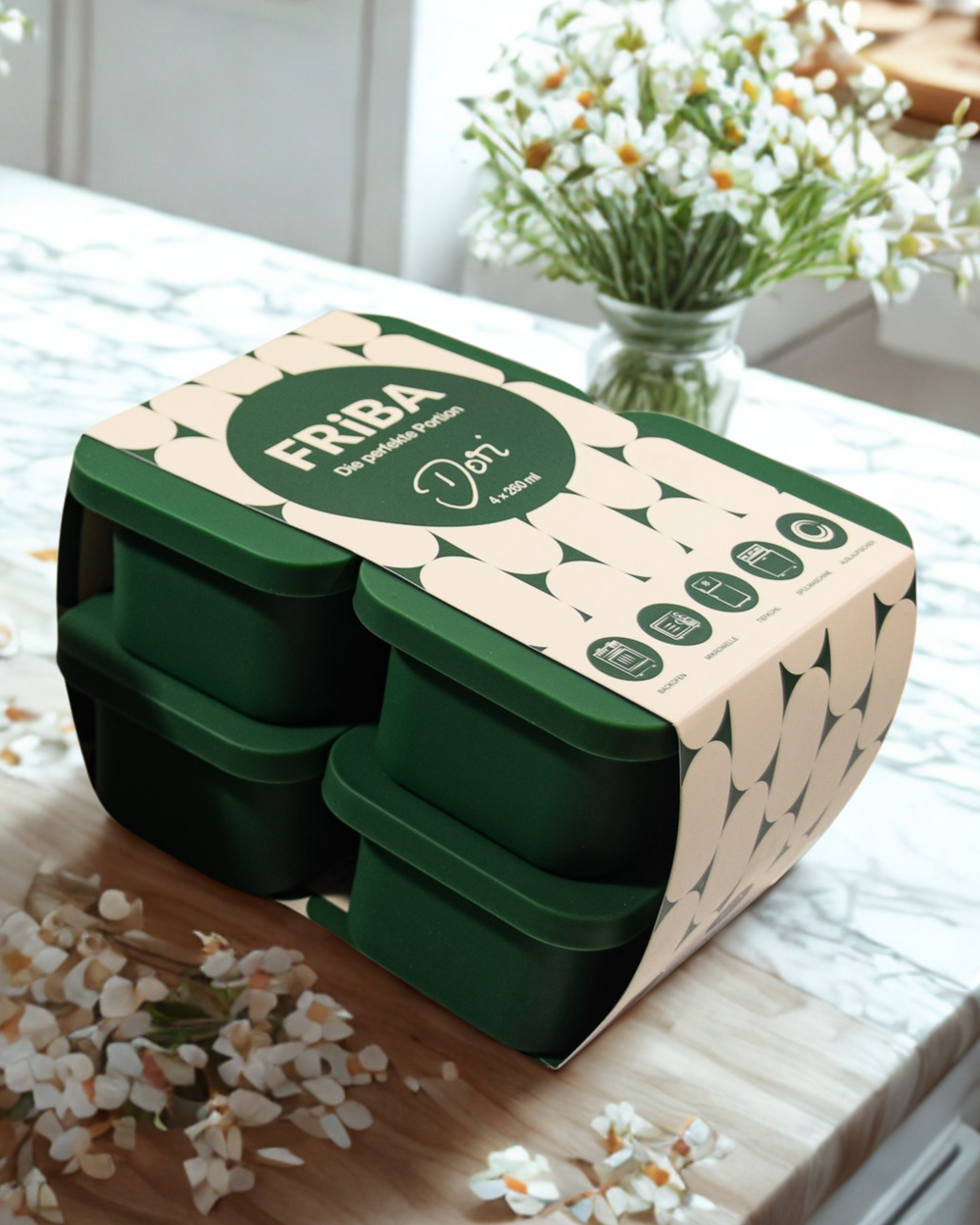
Plastic boxes are common in everyday life – light, inexpensive, and familiar. For simple storage, they are often practical. The more important question is: what happens if you want to heat or further process food in the same container later?
For mere storage, a box is sufficient. As soon as freezing, portioning, and subsequent heating are involved, a well-designed silicone mould usually becomes the more practical solution.
What Swiss sources say
The FOPH makes it clear that packaging, dishes, and kitchen utensils are relevant as food contact materials and are legally regulated. The fundamental question is therefore not what looks practical, but what is suitable for the specific use.
A plastic box is usually good for the refrigerator or freezer – but rarely precise or pleasant for further processing. A good silicone mould takes on several roles at once.
Box or silicone mould – the direct comparison
| Aspect | Plastic box | FRiBA Silicone Mould |
|---|---|---|
| Storage | Good | Good, with lid |
| Freezing | Yes | Yes, down to −50 °C |
| Heating / Oven | Often limited | Oven-safe up to 250 °C |
| Portioning | Seldom exact | ml scale |
| Stability | Mostly OK | Metal frame |
| Multiple steps | One task | Preparation to heating |
What really matters
In everyday life, it's not just about material, but about processes: How many steps do you need? Do you have to transfer contents? Does the container remain stable? This is where it becomes clear whether something is just stored or actually simplifies everyday kitchen life.
- For pure storage, a plastic box may suffice.
- Packaging and kitchen utensils are legally regulated (FOPH).
- A silicone mould handles storing, freezing, portioning, and heating.
- Metal frames, lids, and ml scales make the difference in everyday life.
- FOPH - Materials and articles in contact with food
- FOPH - Packaging
- FOPH - Dishes and kitchen utensils
