
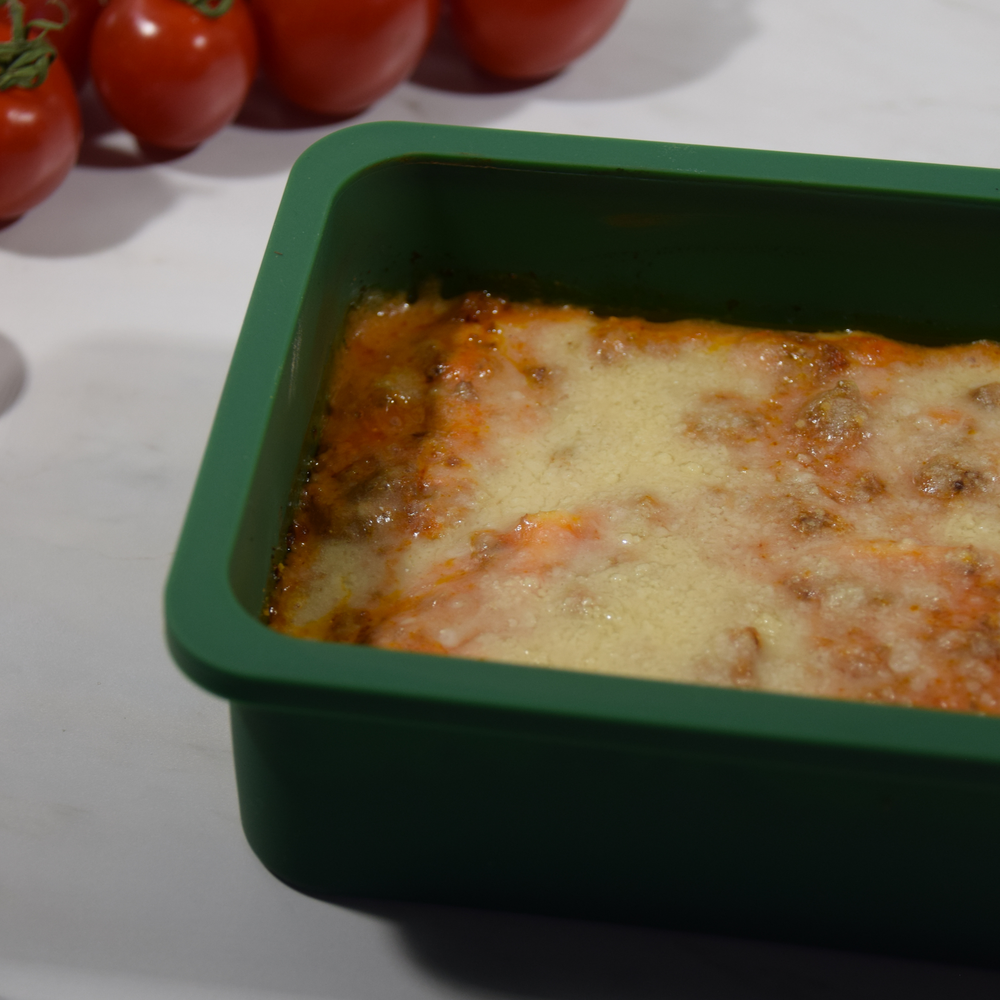
First thaw, then transfer, then put into another dish – and in the end, more dirty dishes, more mess, more wasted time. Anyone who preps and freezes meals knows this point of friction. But can it be done directly: from freezer to oven?
Yes – many foods can generally be safely cooked from a frozen state. The key is the interaction of safe preparation, a suitable form, and a material that can withstand significant temperature differences.
The Question Behind the Problem
The actual meal is already there, but the path to it is unnecessarily complicated. That's why many are looking for a solution that not only sounds practical in theory but actually works in everyday life – without intermediate steps, without additional dishes.

What Official Bodies Say
The U.S. Department of Agriculture (USDA) indicates that it can be safe to cook many foods from a frozen state. At the same time, the agency emphasizes: cooking time may be longer, and the safe internal temperature must be reached in the end.
“Directly into the oven” is often understood too broadly. The step only becomes safe when both food handling and the material are correct.
Why the Material is So Crucial
Not every container is made for extreme temperature changes – this is where most everyday problems arise. So the question is not just: “Can the material withstand the heat?” but also: “Can it be used stably and cleanly?”
FDA & EFSA: Food Contact Materials
Both the FDA and the European Food Safety Authority (EFSA) address this very question under the term Food Contact Materials – materials that come into contact with food. Substances must not transfer to the food in objectionable ways. In short: the material is not a minor detail, but a central part of product safety.
Plastic, Glass, Silicone – What Really Holds Up?
Practical for storage, but not for high oven temperatures.
Can crack with drastic temperature changes.
Flexible, but bends when filling or carrying.
Metal frame for form stability, from −50 to +250 °C.

The Real Everyday Test: Stability
What feels soft and pleasant when empty can quickly become impractical when filled. As soon as a dish is liquid, heavy, or frozen, you realize whether a form is truly well-designed. That's why the metal frame in FRiBA is not a small extra, but one of the most important everyday advantages.
As soon as a dish is liquid, heavy, or frozen, you realize whether a form is truly well-designed.
Why FRiBA Solves Several Problems Simultaneously
What You Should Still Pay Attention To
Not every application is automatically uncritical. Cooking times will be longer, and with sensitive foods, the safe internal temperature must be reached in the end. Always observe the manufacturer's product instructions. A good form makes many things easier – but it doesn't replace basic food safety rules.
Conclusion
From freezer directly to oven – yes, this can be practical and sensible. The crucial factors are the right material, safe preparation, and a form that not only withstands heat but also can be used stably in everyday life. Less transferring. Less wobbling. More control. More calm in the kitchen.
- Many foods can be safely cooked from frozen – time, temperature, and application are crucial.
- Food Contact Materials are safety-relevant – as indicated by the FDA and EFSA.
- Not only heat resistance counts, but also everyday usability and stability.
- FRiBA combines a metal frame, lid, and ml scale – oven-safe and freezer-safe.
- USDA Food Safety and Inspection Service - The Big Thaw: Safe Defrosting Methods
- USDA Food Safety and Inspection Service - Leftovers and Food Safety
- FDA - Food Packaging & Substances that Come into Contact with Food
- EFSA - Food contact materials
